 |
|||||||||||||||
 |
|||||||||||||||
 |
 |
||||||||||||||
 |
|||||||||||||||
 |
 |
||||||||||||||
| Home>Interviews | |||||||||||||||
|
Interviews
Is there a role for Critical Pedagogy in Language/Culture Studies?
Manuela Guilherme Centro de Estudos Sociais Henry Giroux became established as a leading figure in radical education theory in the 1980s. Not only did he revive the arguments for civic education proposed by the main educational theorists of the 20th century, namely Dewey, Freire and others such as the reconstructionists Counts, Rugg and Brameld, but he also advanced their theories by expanding them into the idea of a ‘border pedagogy’. His proposal can be viewed as the application of a post-colonial cosmopolitan perspective to the North American notion of democratic civic education. Giroux provides us with a vision for education that addresses the challenges which demographically and politically changing western societies are facing at the beginning of the 21st century. The longer it takes for policy makers in education to take his guidance seriously, the more time and possibilities we will all be wasting and missing. In fact, educators at all levels of the educational system and all over the world are experiencing growing de-motivation and even frustration because they feel they have been forced backwards lately instead of moving forwards in challenging themselves, both as professionals and citizens, to meet the needs of our fast-changing societies. Giroux has urged educators and academics to react against these paralysing pressures and to be critical, creative and hopeful about the potential that both they and their students offer, in order to counter the conservative political tendencies which have been imposing a definition of excellence in education that means submission to market pressures rather than educational excellence in terms of innovative intellectual production. Giroux argues for both critique and possibility in education and advocates independence and responsibility for teachers and students, that is, he claims dignity and respect for educational institutions, teachers and students. Giroux has bravely recovered the political nature of the everyday labor of educational researchers and of educators themselves. Furthermore, Giroux has also eloquently theorized a critical pedagogy of Cultural Studies based on what was proposed by the educationalist Raymond Williams himself. In fact, the field of Cultural Studies has been problematised, and is itself problematic, although very rich and promising, since it has broken down the barriers between disciplines. Therefore, it needs to be fully theorised in order to describe its goals, as well as the bases of its knowledge and processes. Giroux has made important contributions to these processes by mapping the relationships between language, text, society, new technologies and underlying power structures. He has thus responded to its critics and to those academics who have adhered to it in order to follow fashion or find a way out of their now neglected traditional disciplines. In addition, he has indicated new paths that go beyond recuperating Williams’ and Hall’s politically committed and scientifically founded new field of Cultural Studies and move into examining the implications of new technologies in the exchange and re-creation of new knowledge within new power relationships. It is nonetheless worth mentioning that Giroux has also been successful in identifying new modes of representation and learning. MG: In your work, you show a deep and consistent concern for civic life in a globalized world. How do you define a more globalized form of citizenship?
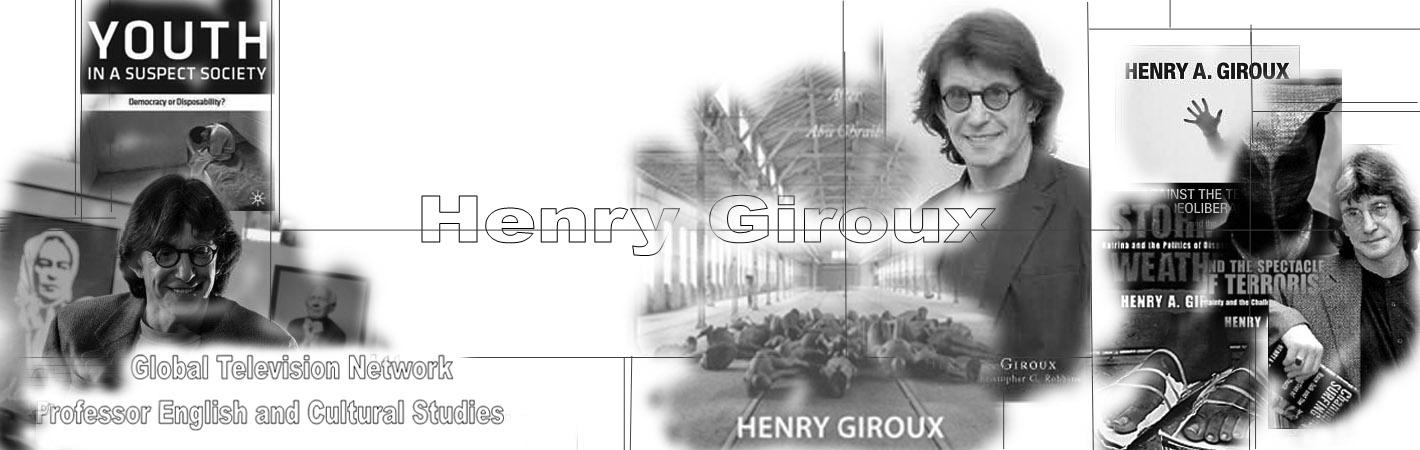
MG:What specific capacities does this new cosmopolitan citizen need to develop? HG: Citizens for a global democracy need to be aware of the interrelated nature of all aspects of physical, spiritual, and cultural life. This means having a deep-rooted understanding of the relational nature of global dependencies, whether we are talking about the ecosphere or the circuits of capital. Second, citizens need to be multi-literate in ways that not only allow them access to new information and media-based technologies, but also enable them to be border crossers capable of engaging, learning from, understanding, and being tolerant of and responsible to matters of difference and otherness. This suggests reclaiming as central to any viable notion of citizenship, the values of mutual worth, dignity, and ethical responsibility. At stake here is the recognition that there is a certain civic virtue and ethical value in extending our exposure to difference and otherness. Citizens need to cultivate loyalties that extend beyond the nation-state, beyond a theoretical distinction in which the division between friend and enemy is mediated exclusively around national boundaries. Clearly, citizenship as a form of empowerment means acquiring the skills that enable one to critically examine history, and resuscitate those dangerous memories in which knowledge both expands the possibilities for self-knowledge and critical and social agency. Knowledge cannot be only indigenous to be empowering. Individuals must also have some distance from the knowledge of their birth, origins, and specificity of place. This suggests appropriating those knowledges that emerge through dispersal, travel, border crossings, diaspora, and through global communications. A cosmopolitan notion of citizenship must recognize the importance of dissent and a culture of questioning to any global concept of democracy. The global public sphere must be a place where authority can be questioned, power held accountable, and dissent seen as having a positive value. There is a growing authoritarianism in many parts of the world, particularly the United States. In facing this threat to democracy around the globe, it is crucial for educators, parents, young people, workers, and others to fight the collapse of citizenship into forms of jingoistic nationalism. This means educators and others will have to reinvigorate democracy by assuming the pedagogical project of prioritizing debate, deliberation, dissent, dialogue, and public spaces as central to any viable notion of global citizenship. In addition, If citizenship is to be global, it must develop a sense of radical humanism that comprehends social and environmental justice outside of national boundaries. Human suffering does not stop at the borders of nation-states. MG: In my view, one of your most inspiring proposals is the claim for a more dignifying and committed role of the educator at all levels of the educational system. Do you confirm this as one of your main goals? How do you summarise the main goals of your writing? MG: You also propose a close link between theory and practice, which have been made separate in our academic systems and in our societies. Can you please expand on the advantages of linking them for the purposes of citizenship education? HG: Citizenship education must take seriously the connection between theory and practice, reflection and action. All too often, theory in academia slides into a form of theoreticism in which theory either becomes an end in itself, relegated to the heights of an arcane, excessive and utterly ethereal existence or it degenerates into a form of careerism, offering the fastest train to academic prominence. But theory is hardly a luxury connected to the fantasy of intellectual power. On the contrary, theory is a resource that enables us to both define and respond to problems as they emerge in particular contexts. Its transformative power resides in the possibility of enabling forms of agency not in its ability to solve problems. Its politics is linked to the ability to imagine the world differently and then to act differently and this is its offering to any viable notion of citizenship education. At stake here is not the question whether theory matters, which should be as obvious as asking whether critical thought matters, but the issue of what the political and public responsibilities of theory might be, particularly in theorizing a global politics for the twenty-first century. Theory is not just about contemplation or paving a way to academic stardom, it is foremost about intervention in the world, raising ideas to the worldly space of public life, social responsibility, and collective intervention in the world. If learning is a fundamental part of social change, theory is a crucial resource to studying the full range of everyday practices that circulate throughout diverse social formations and to find better forms of knowledge and modes of intervention in the face of the challenge of either a growing authoritarianism or a manufactured cynicism. MG: You have often been accused of equating education with instilling ideological propaganda in their students and you have rejected these accusations by pointing critical pedagogy. How, do you think, does a critical pedagogy promote a free mind? HG: Far from instilling propaganda in students, I think critical pedagogy begins with the assumption that knowledge and power should always be subject to debate, held accountable, and critically engaged. Central to the very definition of critical pedagogy is a common concern for reforming schools and developing modes of pedagogical practice in which teachers and students become critical agents actively questioning and negotiating the relationship between theory and practice, critical analysis and common sense, and learning and social change. This is hardly a prescription for propaganda. I think critical pedagogy is often seen as dangerous because it is built around a project that goes to the very heart of what education is about and is framed around a series of important and often ignored questions such as: “Why do we [as educators] do what we do the way we do it”? Whose interest does schooling serve? How might it be possible to understand and engage the diverse context in which education takes place? But critical pedagogy is not concerned simply with offering students new ways to think critically and act with authority as agents in the classroom, it is also concerned with providing teachers and students with the skills and knowledge to expand their capacities to both question deep- seated assumptions and myths that legitimate the most archaic and disempowering social practices that structure every aspect of society and to take responsibility for intervening in the world. In other words, critical pedagogy forges critique and agency through a language of scepticism and possibility. MG: The relevance of humanities departments in universities worldwide is being reconsidered by the university management, by the LABOR market and THE WIDER society MORE GENERALLY. How can, in your opinion, those departments face the challenge not only of survival but also of countering the “crisis of culture”, which you cite from Raymond Williams, and of reclaiming their relevance? HG: In recent years, I have been working out of a series of projects which address a number of interrelated concerns: the substantive role of culture, in particular popular culture, as the primary site where pedagogy and learning take place, especially for young people; the role that academics and cultural workers might assume as public intellectuals mindful of the constitutive force culture plays in shaping public memory, moral awareness, and political agency; the significance of the university, specifically the humanities, as a public sphere essential to sustaining a vibrant democracy yet under assault by the forces of corporatization, and the centrality of youth as an ethical register for measuring the changing nature of the social contract since the 1980s and its implications for a broader discourse on hope and the future. The humanities traditionally have offered both a refuge and a possibility for thinking about these issues, though under historical conditions which bear little resemblance to the present. This is particularly evident as the conditions for the production of knowledge, national identity, and citizenship have changed in a rapidly globalizing, post-9/11 world order marked by the expansion of new electronic technologies; the consolidation of global media; Western de-industrialization, deregulation, and downsizing; the privatization of public goods and services; and the marketization of all aspects of social life. MG: You challenge the traditional understanding of the word ‘intellectual’. How does this notion apply to the contemporary world? HG: I have always believed that the notion of the intellectual carries with it a number of important political, cultural, and social registers. In contrast to the notion that intellectuals are a specialized group of experts, I have argued that everybody is an intellectual in that we all have the capacity to think, produce ideas, be self-critical, and connect knowledge (wherever it comes from) to forms of self and social development. At the same time, those intellectuals who have the luxury of defining their social function through the production of intellectual ideas have a special responsibility to address how power works through the institutions, individuals, social formations, and everyday life so as to enable or close down democratic values, identities, and relations. More specifically, I believe that the most important obligation that intellectuals have to knowledge is through understanding its relationship to power not as a complementary relation but as one of opposition. I think intellectuals whether in or outside of the academy must connect ideas to the world and engage their skills and knowledge as part of a larger struggle over democratic ideas, values and justice. Intellectuals have a responsibility not only to make truth prevail in the world and fight injustice wherever it appears, but also to organize their collective passions to prevent human suffering, genocide, and diverse forms of unfreedom linked to domination and exploitation. Intellectuals have a responsibility to analyze how language, information, and meaning work to organize, legitimate, and circulate values, structure reality, and offer up particular notions of agency and identity. For public intellectuals, the latter challenge demands a new kind of literacy and critical understanding with respect to the emergence of the new media and electronic technologies, and the new and powerful role they play as instruments of public pedagogy. Critical reflection is an essential dimension of justice and is central to civic education, and it is precisely with respect to the keeping justice and democracy alive in the public domain that intellectuals have a responsibility to the global world. Today, the concept of the intellectual, as Pierre Bourdieu reminds us, has become synonymous with public relations, syncophantic apologists, and fast-talking media types. Educators as public intellectuals need a new vocabulary for linking hope, social citizenship, and education to the demands of substantive democracy. I am suggesting that educators need a new vocabulary for connecting not only how we read critically but also how we engage in movements for social change. I also believe that simply invoking the relationship between theory and practice, critique and social action will not do. Any attempt to give new life to a substantive democratic politics must address both how people learn to be political agents and, what kind of educational work is necessary within many kinds of public spaces to enable people to use their full intellectual resources to both provide a profound critique of existing institutions and struggle to work towards fulfilling the promise of a radical global democracy. As public intellectuals, educators and other cultural workers need to understand more fully why the tools we used in the past feel awkward in the present, often failing to respond to problems now facing the United States and other parts of the globe. More specifically, we face the challenge posed by the failure of existing critical discourses to bridge the gap between how the society represents itself and how and why individuals fail to understand and critically engage such representations in order to intervene in the oppressive social relationships they often legitimate. By combining the mutually interdependent roles of critic and active citizen, intellectual work at its best can exercise civic courage as a political practice, a practice that begins when one’s life can no longer be taken for granted. Such a stance not only connects intellectual work to making dominant power accountable, it also makes concrete the possibility for transforming hope and politics into an ethical space and public act that confronts the flow of everyday experience and the weight of social suffering with the force of individual and collective resistance and the unending project of democratic social transformation. The road to authoritarianism begins when societies stop questioning themselves and, when such questioning stops, it is often because intellectuals either have become complicit with such silence or they actively produce it. Clearly, critical intellectuals have a responsibility to oppose this deafening quiet in the face of an emerging global barbarism, evidence of which can be seen in a number of growing religious, political, and economic fundamentalisms. MG: One of your most radical statements is that every educational act is political and that every political act should be pedagogical. In the same way that your work crosses into different disciplinary areas, you have also tried to link different institutional divisions in which pedagogy takes place: education, politics and the media, just to name a few. What are your reasons for and the risks of such an undertaking? HG: In the last few decades, I have tried to resurrect the profound insights of theorists such as Antonio Gramsci, Raymond Williams, Edward Said, and others who have argued that the educational force of the broader culture has become one of the most important political sites in the struggle over ideas, values, and agency. Permanent education is a fundamental part of what it means to create those identities and values that constitute the narrative of what constitutes the political. In the past, education was limited to schooling, but it has become clear that most of the education that takes place today, which is so vital to any democracy, takes place in a broader number of sites including screen culture, popular culture, the Internet, and in the all-encompassing old and new media. I have stressed that these new sites of education, which I call the realm of public pedagogy, are crucial to any notion of politics because they are the sites in which people often learn, unlearn, or simply do not get the knowledge and skills that prepare them to become critical agents, capable of not merely understanding the society and world in which they live but also being able to assume the mantle of governance. MG: You have dedicated a great amount of your recent work to what you consider an unfair treatment of the youth in contemporary societies by both public and private institutions (e.g., the government, the educational system, the press and society in general). What specific role can educators play in countering this trend? HG: Well, the first thing they can do is to recognize the obligation that adults have to youth if in fact we are going to take seriously not only the social contract but the very possibility of a democratic future. The second thing that can be done is to try to understand those forces, especially neoliberalism, neoconservatism, militarism and religious fundamentalism, that view youth either as a commodity or as utterly expendable, especially poor youth and youth of color, and how they can be challenged in every social institution and addressed through policies that truly view youth as a social investment rather than a threat, fodder for the military, or a commodity. MG: How do you view the introduction of a new academic interdisciplinary subject that aims to develop intercultural competencies, that is, to improve the students’ capacity to communicate and interact effectively across cultures, both nationally and internationally? How can educators implement this interdisciplinary and intercultural subject within a critical pedagogy approach? Does this project relate to your claims for a “new language for expressing global solidarity”? HG: I think that the question of intercultural competencies has to be understood within a broader notion of literacy linked to both the acquisition of agency and the ability to recognize that matters of difference are inextricably tied to issues of respect, tolerance, dialogue, and our responsibility to others. Multicultural literacy as a discursive intervention is an essential step toward not only a broader notion of self-representation, but also a more global notion of agency and democracy. Literacy in this sense not only is pluralized and expanded, it is also the site in which new dialogical practices and social relations become possible. Literacy as I am using it here does a kind of bridging work necessary to democracy while also offering up modes of translation that challenge strategies of common sense and domination. At the same time, intercultural competencies must be connected to the central dynamics of power as a way of engaging differences and exclusions so as to understand their formations as part of a historical process of struggle and negotiation. In this instance, such competencies further more than understanding and awareness; they also serve as modes of critical understanding in which dialogue and interpretation are connected to modes of intervention in which cultural differences can be viewed as an asset rather than a threat to democracy. MG: Your writing style is very powerful and idiosyncratic and you have been both criticised and praised for it. Some of your readers find it too obscure and impregnated with ideology and others find it vibrant, stimulating and very inspiring. I belong to the latter and I would like to ask you to what extent its use is purposeful and what purposes it serves? HG: I have tried in the last decade to make my writing accessible to a broader public while [delete at the same time] not compromising its theoretical rigor. This seems to present a lot of problems for those academics whose discourse is largely impenetrable, highly specialized, and plugged into narrow definitions of careerism. Academics, especially on the Left in the United States, are generally very bad writers, a problem connected less to matters of skill than to an arcane notion of professionalism. Many live in “theory world” and generally address very specialized audiences. On the one hand, much of their work is indebted to a kind of postmodern irony or cleverness, or is so pedantic, that it lacks either any political integrity or passion. On the other hand, the bar has been set so low in the United States around matters of clarity and style that it is always difficult to reach a broader public if conventional matters of style and language are challenged, as they are in my work. Of course, the grumbling about my work is not merely about style, it is also because I often make the political primary to my work in a way that makes the project I am working out of quite clear. The backlash against committed writing, if not engaged politics, is so strong in universities, the media and other established sites of public pedagogy that asserting the importance of politics as a crucial aspect of everyday life and learning is an incredibly difficult but absolutely necessary fight to wage. MG: You have been very critical about what the contemporary developed world is providing to the youth, namely more surveillance in schools, the so-called excellence in education translated into more standardised assessment, a commercialised culture, etc. I have no doubts that you are very aware that it is difficult for critical educators, as individual professionals burdened themselves by the demands of the government, the school management, students and parents, and society as a whole, to counter these tendencies on their own. Your writings have undoubtedly inspired and supported their efforts. Do you have any special message for them? HG: Yes, these are very difficult times, but the stakes are very high and if we value democracy, and have any hope whatsoever for the future we must continue the struggle for connecting education to democracy, learning to social change, and excellence to equity. The only other option is either cynicism or complicity and no educator deserves that. I also think it is important to recognize that these struggles are going on all over the world, and that we are not alone and shouldn’t be alone in taking on these crucial battles, battles that will determine the fate of global democracy in the twenty-first century. How do you account for the increasing interest of foreign language/culture educators in your work, despite their traditional little interest in the critical theories of schooling and pedagogy? Of course, one has to recognize that historically there have been a number of foreignlanguage/culture educators who have addressed the connection between language and critical pedagogy, particularly people Henry Giroux moved to Canada in 2004 and currently holds the Global Television Network Chair in Communication Studies at McMaster University. Although his parents were original from Canada, he was born and lived in the United States until this recent move. Having started his career in education as a high school teacher of history, he achieved a distinguished academic career for which he has recognized internationally. Giroux is a member of various Editorial Boards of relevant national and international journals in the fields of Education and Cultural studies and several of his books received awards by the American Educational Studies Association as the most significant volumes of the respective year of publication. The list of his publications is immense including several books, chapters in many volumes and articles in the leading journals focusing on different areas connected with education and cultural studies, and can be found in his website (www.henryagiroux.com ). Manuela Guilherme is a senior researcher at the Center for Social Studies, University of Coimbra in Portugal, where she coordinates two European projects focusing on Intercultural Education ( www.ces.uc.pt/researchers ; www.ces.uc.pt/icopromo ; www.ces.uc.pt/interact ). She is the author of Critical Citizens for an Intercultural World: Foreign language education as cultural politics (Multilingual Matters, 2002), where she draws on Giroux’s theories, and co-editor of Critical Pedagogy: Political approaches to language and intercultural communication (Multilingual Matters, 2004) which includes Giroux’s chapter entitled “Betraying the intellectual tradition: Public intellectuals and the crisis of youth”. |
|||||||||||||||
 |
|
|
|
|
|
|
|
|
|
|
|
|
|
|
|